Committing to a full sleeve project represents a significant shift from acquiring standalone pieces, demanding a comprehensive architectural approach rather than simple image selection. The client must first distinguish between a unified cohesive sleeve that utilizes a single background to connect elements, and a patchwork style built from individual, collected designs. The success of this large-scale investment relies heavily on respecting anatomical flow because a static image that looks perfect on a flat screen often distorts when wrapped around the curvature of the biceps or inner elbow.
I, Minh Pham, have developed a strategic planning protocol to navigate this complex timeline. This guide analyzes the essential criteria for selecting a large-scale specialist, defining the financial structure of a multi-session project, and preparing for the inevitable “awkward healing phase” in the article below.
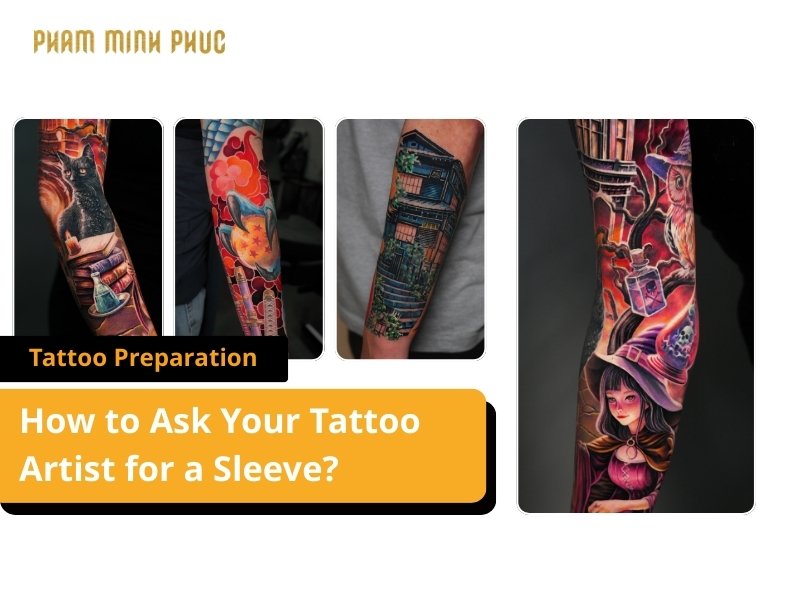
Table of Contents
Step 1: Decide Your Style (Patchwork vs Cohesive)
Before approaching an artist, you must distinguish between the two primary structural approaches to sleeve tattooing. This decision dictates the entire design process and artist selection.
- Cohesive Sleeves: These feature a single background (clouds, water, geometry) that unifies multiple focal points. The entire arm is planned as one large-scale composition to ensure perfect flow from shoulder to wrist. This requires a specialist who understands different tattoo styles like Japanese Irezumi or Realism, where background elements are as critical as the main subjects.
- Patchwork Sleeves: This style consists of individual, standalone tattoos collected over time. Gaps are eventually filled with small “filler” designs or left open. This approach allows for more spontaneity but lacks the fluid visual movement of a cohesive piece.
Step 2: Pitching Your Theme
Communicating your vision requires balancing clarity with creative freedom. You should provide a “mood board” that defines the narrative (mythology, family, nature) and the aesthetic (dark/contrast vs. light/ethereal).
Avoid dictating the exact placement of every element. A professional artist understands anatomy better than a client does. I design the “flow” to wrap around the curvature of the biceps and triceps, ensuring the image does not distort when the arm twists. Micromanaging placement often results in a stiff, awkward tattoo that fights against the body’s natural lines. Instead, present your core concepts and allow the artist to map them onto your muscle structure for maximum visual impact.
Step 3: Finding the Right Artist for Your Sleeve Tattoo
Selecting the primary architect for your sleeve is the single most critical decision in this process. Unlike a standalone piece, a sleeve requires an artist with mastery over large-scale composition and anatomical flow. You are entering a long-term professional relationship that will span months; choosing the wrong artist results in disjointed imagery and inconsistent quality.
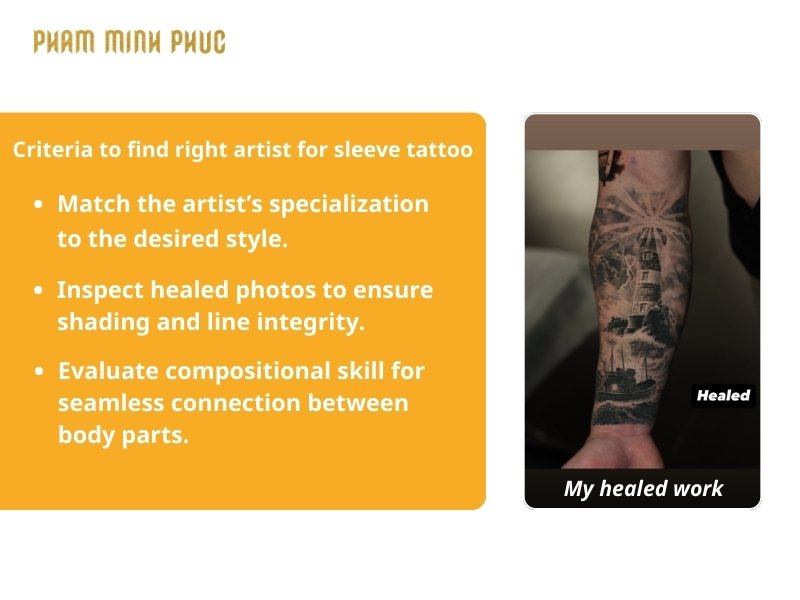
You must evaluate candidates based on these specific criteria:
- Specialization Alignment: Do not ask a specialist in American Traditional to execute a hyper-realistic Black and Grey sleeve. The artist’s core portfolio must mirror the specific aesthetic you defined in Step 1.
- Healed Portfolio: Fresh ink always looks vibrant. You need to inspect healed photos of their large-scale work to verify that their shading remains smooth and their lines hold integrity after the skin settles.
- Compositional Skill: Look for examples where they have successfully connected the shoulder, elbow, and wrist. A skilled sleeve artist hides the “seams” between sessions, creating a unified image rather than a patchwork of disconnected stickers.
Step 4: Prepare Consultation Checklist (Questions to Ask)
A sleeve consultation differs significantly from a standard appointment. You are committing to a relationship that may last months or years. You need to verify that the artist has the logistical capacity and technical skill for large-scale work.
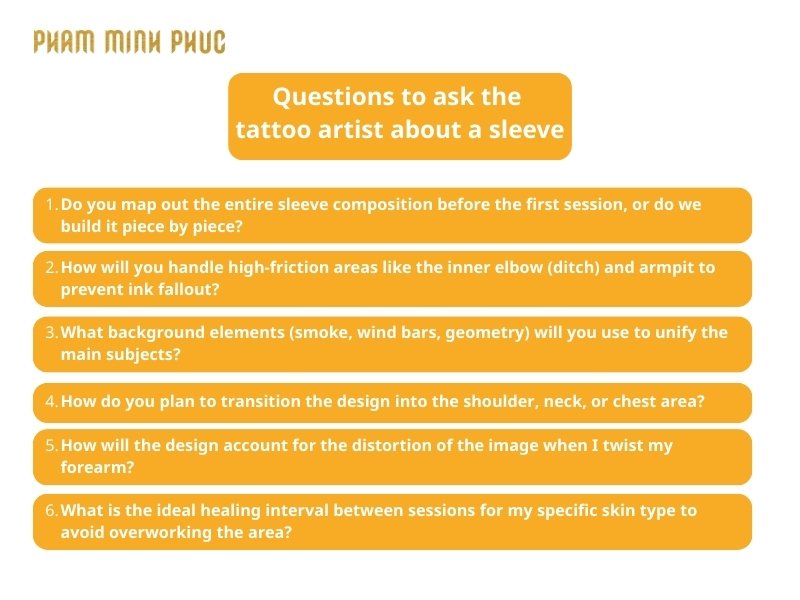
Bring this specific checklist of what to ask your tattoo artist to ensure total alignment on the project:
- Do you map out the entire sleeve composition before the first session, or do we build it piece by piece?
- How will you handle high-friction areas like the inner elbow (ditch) and armpit to prevent ink fallout?
- What background elements (smoke, wind bars, geometry) will you use to unify the main subjects?
- How do you plan to transition the design into the shoulder, neck, or chest area?
- How will the design account for the distortion of the image when I twist my forearm?
- What is the ideal healing interval between sessions for my specific skin type to avoid overworking the area?
- Do you charge a flat day rate for large-scale projects, or is it strictly an hourly billing structure?
- What is your policy on touch-ups once the entire sleeve is completed and fully settled?
Step 5: Discussing the Timeline and Money
A high-quality sleeve is a financial marathon. Transparency regarding your budget prevents mid-project delays. Most sleeves require 20 to 40+ hours of needle time, depending on the detail level and the size of your arm.
You must discuss the financial structure upfront. Some artists charge a flat day rate, while others bill hourly. Understanding the average tattoo prices in San Antonio helps you set a realistic budget ceiling. Furthermore, you need to clarify the expected tattoo session length to ensure the appointments align with your daily schedule.
Clarifying these constraints is vital to prevent project abandonment. A defined payment schedule ensures your budget sustains the entire process, saving you from the frustration of pausing mid-sleeve and living with unfinished line work due to unforeseen financial exhaustion. I typically recommend sessions spaced 3 to 4 weeks apart to allow the skin to fully regenerate, ensuring the next layer of ink settles correctly without causing trauma.
Step 6: Planning for the “Awkward Phase”
Every sleeve goes through an intermediate stage where the work looks incomplete. You might walk around with just bold outlines or a half-shaded forearm for several months.
Mentally preparing for this “Awkward Phase” is essential. You cannot rush the healing process. Pushing for back-to-back sessions before the dermal layer has recovered increases the risk of infection and ink fallout. Patience ensures the final result remains vibrant for decades rather than looking overworked and scarred.
You must treat the unfinished tattoo with the same rigor as a finished piece. The quality of the final layer depends entirely on how well the previous layer healed.
- Sun Protection: Keep the unfinished work covered with clothing. Sun damage on the outline stage will cause the final shading to look muddy.
- Hygiene: Wash the area daily with fragrance-free soap. Do not submerge the arm in pools or lakes, even if the tattoo “looks” healed.
- Moisturizing: Keep the skin hydrated but not suffocated. Dry, cracking skin makes the next session more painful and difficult for the artist to saturate.
Common Mistakes When Asking for a Sleeve
Committing common mistakes when asking for a sleeve can compromise the structural integrity and aesthetic flow of your long-term project. Many enthusiastic clients unknowingly sabotage their vision by ignoring the technical realities of large-scale tattooing. You must avoid these specific pitfalls to ensure a successful collaboration.
- Copying an Existing Sleeve: Asking an artist to replicate a sleeve found on Pinterest is unethical and technically impossible. A custom sleeve is tailored to that specific person’s arm length and circumference. Copying it onto your arm will result in distorted proportions and a lack of flow.
- Ignoring Pain Tolerance: The inner elbow (ditch) and armpit areas are excruciating. Clients often underestimate the stamina required. Reviewing a tattoo pain chart helps you strategize which sessions will require the most mental preparation.
- Failing to Research the Artist: You need a sleeve tattoo artist in San Antonio who specializes in large-scale composition, not just someone who does good small tattoos.
Why Trust Minh Pham with Your Sleeve Project?
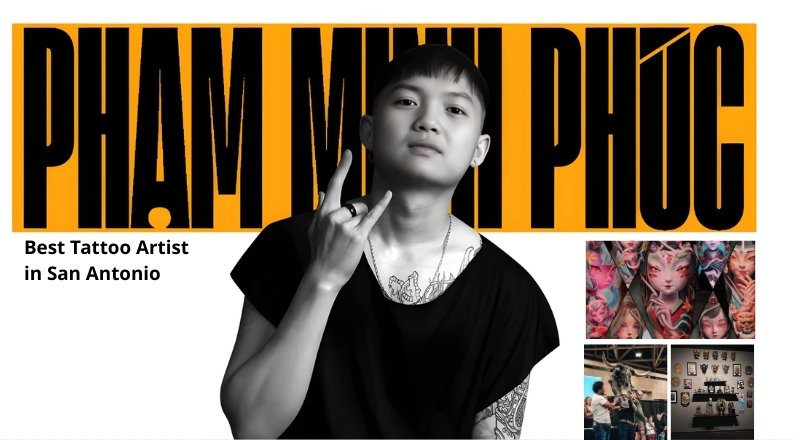
I bring over 10 years of experience and the technical validation of 40+ international awards to every large-scale project. My approach prioritizes the longevity of the art and the safety of the client. As one of the top tattoo artists in San Antonio, Texas, I specialize in architectural body art. I do not just draw on skin; I engineer designs that utilize your body’s natural motion.
I guarantee a world-class experience through these outstanding standards:
- Internationally Recognized Mastery: My technical precision is backed by over 40 international awards. You are trusting your arm to a proven expert who competes and wins on the global stage.
- Anatomical Engineering: I design sleeves that respect the “flow” of your musculature. The artwork moves naturally with your arm rather than distorting when you twist or flex.
- Bespoke Narrative: I reject generic templates. I architect custom concepts that weave your personal story into a cohesive visual narrative, ensuring your sleeve is a one-of-a-kind masterpiece.
- Hospital-Grade Safety: Large-scale work exposes a significant amount of skin. I strictly adhere to medical-grade sterilization protocols to ensure your long-term safety throughout the multiple sessions required.
Explore my custom sleeve tattoo service and discover high-level tattoo artistry designed for bold impact, seamless flow, and long-lasting detail. Every sleeve is carefully crafted to fit your anatomy, tell your story, and stand out as a true masterpiece.
Can You Cover Up An Old Oattoo With a Sleeve?
Yes, a full sleeve is often the best solution for hiding unwanted ink. The large surface area allows for complex imagery that distracts the eye from the old tattoo.
The cover-up section will likely need to be darker or more textured to effectively mask the pigment underneath. This requires a strategic approach where the cover-up becomes a natural part of the new theme. You should read about how to choose a redone tattoo artist to understand the specific skill set required for this type of technical correction.
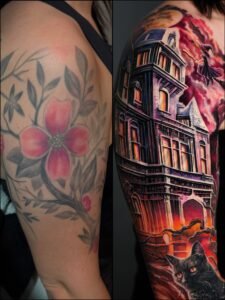
This is one of my signature masterpieces, where I transformed an old tattoo into a stunning custom sleeve tattoo through expert cover-up design, seamless composition, and high-level artistic execution.
Should You Get a Tattoo on The Left or Right Arm?
Your lifestyle determines the best placement. If you drive frequently with your window down, your left arm (in the US) receives significantly more UV exposure, which fades ink faster.
Consider your dominant hand as well. Healing a sleeve limits your range of motion for days after each session. If you have a physically demanding job, tattooing your non-dominant arm first allows you to function more easily during the healing periods.
Does the Arm Swell A Lot?
Swelling is an unavoidable biological response to the trauma of a long session. The arm acts as a gravity well, causing fluids to pool in the extremities.
The swelling is most severe when working near the lymphatic nodes in the armpit or the thin skin of the inner bicep. You can expect the arm to feel tight and look “puffy” for 24 to 48 hours. Elevating the arm and staying hydrated helps reduce this inflammation.
Executing a seamless sleeve requires a partnership with an artist who understands composition and the biological reality of ink migration. By prioritizing healed results over immediate gratification, the client ensures the artwork ages gracefully without becoming a disjointed mess. As a San Antonio-based custom artist, I engineer designs that utilize natural body motion to create a unified masterpiece. If the goal is to transform the arm into a cohesive canvas, I am ready to plan the project.