The tattoo pain chart maps human anatomy into four distinct sensitivity zones ranging from the manageable Zone 1 (Green, score 3-5) on the outer thigh to the excruciating Zone 4 (Red, score 8-10) on the rib cage and armpit. This biological landscape shifts between sexes; women often possess higher endurance in fleshy areas due to natural subcutaneous fat distribution, while men struggle significantly with bony placements. Furthermore, individual factors such as skin elasticity, hydration levels, and the artist’s technique directly alter how the nervous system interprets the needle’s vibration.
I, Minh Pham, have analyzed these variables to create a comprehensive roadmap for your body art journey using over a decade of professional experience. This guide details the specific sensations for every location and provides expert protocols to maximize your physical resilience in the analysis below.
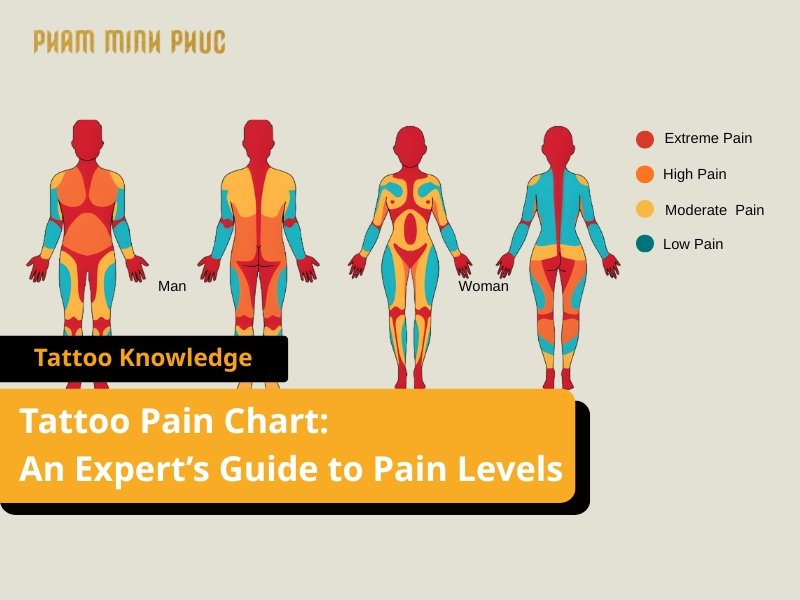
Table of Contents
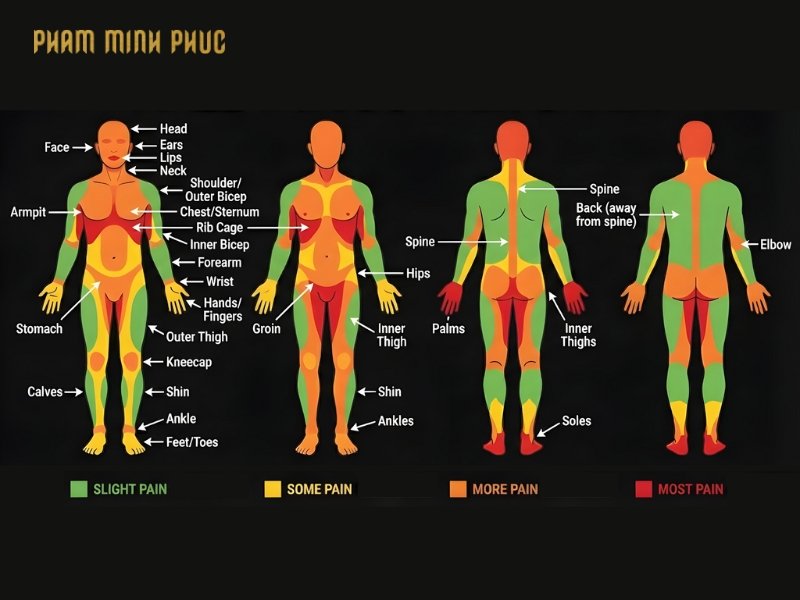
The Master Tattoo Pain Chart: Pain Levels by Body Location
The tattoo pain chart functions as a strategic map for your body art journey. People categorize human anatomy into distinct zones based on the Cushioning Theory, which dictates that areas with fat and muscle absorb needle impact, while bony areas amplify vibration. I created this detailed breakdown to help you identify the optimal placement for specific pain tolerance.
| Body Location | Zone Name | Pain Level (1-10) | Best For | Sensation Type |
| Armpit | Zone 4 (Red) | 9 – 10 | Bodysuit connectors | Raw, burning, overwhelming pain |
| Rib Cage | Zone 4 (Red) | 9 – 10 | Meaningful scripts | Intense vibration, rattling bone |
| Groin | Zone 4 (Red) | 8 – 9 | Private collection | Electric shock, acute sensitivity |
| Inner Thigh | Zone 4 (Red) | 8 – 9 | Leg sleeves | Sharp stinging, thin skin pinch |
| Palms | Zone 4 (Red) | 8 – 9 | High visibility art | Intense scratching, nerve firing |
| Soles | Zone 4 (Red) | 8 – 9 | Hidden novelties | Deep scraping, ticklish torture |
| Chest / Sternum | Zone 3 (Orange) | 7 – 9 | Large centerpieces | Drilling bone vibration, heavy pressure |
| Elbow | Zone 3 (Orange) | 7 – 8 | Sleeve gaps | Sharp stinging, swelling |
| Kneecap | Zone 3 (Orange) | 7 – 8 | Leg sleeves | Direct bone drilling, jarring |
| Ankle | Zone 3 (Orange) | 7 – 8 | Foot cuffs/accents | Sharp bone contact, stinging |
| Shin | Zone 3 (Orange) | 7 – 8 | Large leg pieces | Constant bone vibration |
| Head | Zone 3 (Orange) | 7 – 8 | Scalp ink | Loud noise, jarring vibration |
| Face | Zone 3 (Orange) | 7 – 8 | Cosmetic/Bold art | Sharp stinging, sinus vibration |
| Ears | Zone 3 (Orange) | 7 – 8 | Small accents | Annoying buzzing, cartilage ache |
| Lips | Zone 3 (Orange) | 7 – 8 | Inner lip text | Fast sharp sting, bleeding |
| Neck | Zone 3 (Orange) | 7 – 8 | Job stoppers | Throat vibration, gag reflex |
| Spine | Zone 3 (Orange) | 7 – 8 | Vertical scripts | Nerve rattling, involuntary spasms |
| Hips | Zone 2 (Yellow) | 6 – 7 | Flowing designs | Bone proximity ache, sharp spots |
| Hands / Fingers | Zone 2 (Yellow) | 6 – 7 | Small symbols | Bony sharpness, thin skin ache |
| Feet / Toes | Zone 2 (Yellow) | 6 – 7 | Small designs | Bony scraping, thin skin |
| Wrist | Zone 2 (Yellow) | 5 – 6 | Bracelets/Symbols | Sharp pinching over veins |
| Inner Bicep | Zone 2 (Yellow) | 5 – 6 | Hidden text/art | Continuous burning, tender skin |
| Stomach | Zone 2 (Yellow) | 4 – 6 | Large torso pieces | Dull ache, heavy stretching |
| Calves | Zone 1 (Green) | 4 – 5 | Portraits/Realism | Muscle absorption, dull scratch |
| Outer Thigh | Zone 1 (Green) | 3 – 4 | Large fleshy canvases | Dull, tolerable pressure |
| Shoulder / Outer Bicep | Zone 1 (Green) | 3 – 4 | First tattoos | Background buzzing, mild ache |
| Forearm | Zone 1 (Green) | 3 – 4 | Visibility/Scripts | Mild scratching, easy tolerance |
| Back (away from spine) | Zone 1 (Green) | 3 – 4 | Large murals | Heavy pressure, manageable burn |
Male vs Female Pain Charts: The Biological Differences
Biological sex influences pain perception through distinct hormonal and anatomical mechanisms. Extensive research by Dr. Roger Fillingim and colleagues (published in The Journal of Pain) indicates that while women may exhibit higher sensitivity to surface stimuli, they often possess superior coping mechanisms for prolonged stressors compared to men.
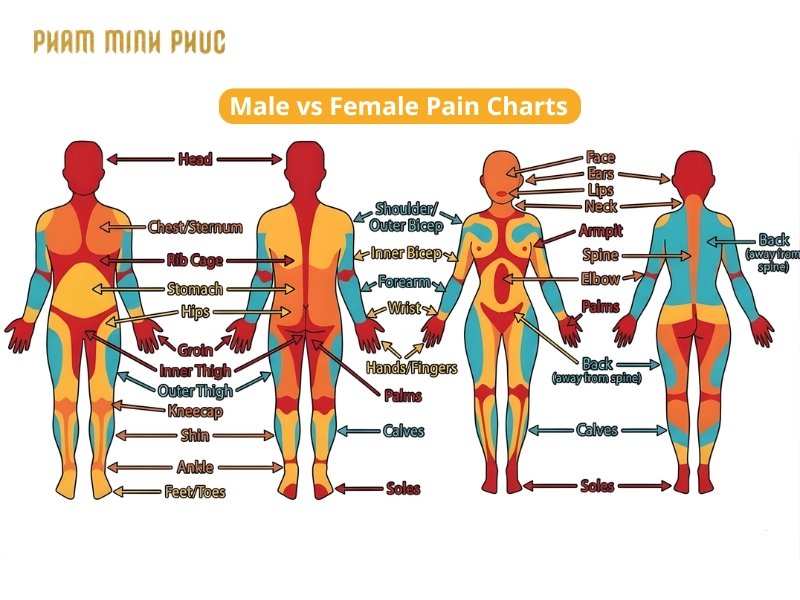
Anatomically, women often exhibit superior pain tolerance in the hips, outer thighs, and glutes due to natural subcutaneous adipose tissue distribution. While evolutionary biology suggests women possess a higher overall pain threshold, skin sensitivity fluctuates with hormonal cycles. Tattoos on the inner arm or thigh may feel sharper during menstruation when the body is prone to inflammation; therefore, I advise female clients to schedule large sessions during the middle of their cycle to maximize physical resilience.
Conversely, men typically endure long sessions on the upper back or shoulders with more ease. Men possess thicker epidermal layers in these zones, which desensitizes the nerves to the prolonged “scratching” sensation of shading. However, men report significantly higher pain intensity in bony areas like the rib cage or spine due to the lack of protective fat cushioning compared to the female torso.
What Are The Extreme Pain Areas For Tattoos?
Extreme pain areas are located in Zone 4 (Red), representing the absolute peak of the pain scale with a rating of 8 to 10. These placements feature a brutal combination of high nerve density and zero protective padding, often triggering involuntary physical reactions due to the intensity.
- Armpits (Axilla): The skin here is incredibly thin and holds major lymph nodes. The armpit generates a raw, burning sensation comparable to an electric shock over an open wound.
- Rib Cage: Skin covers the bone structure with minimal fat cushioning. The rib cage amplifies vibration that rattles the entire chest cavity with every breath, making it best for small scripts.
- Groin: This region possesses the highest concentration of nerve endings in the human body. The groin creates an acute, drilling pain often likened to systemic shock.
- Inner Thigh: The dermis is extremely thin and prone to pinching near the groin. The inner thigh experiences a sharp stinging sensation that is difficult to manage during leg sleeves.
- Palms: Tough skin packed with sensory nerves defines this placement. Tattooing the palms feels like intense scratching or nerve firing, usually reserved for high-visibility art.
- Soles: Deep scraping and a unique “ticklish torture” sensation occur here. The soles are notoriously difficult to heal and are often used for hidden novelties.
What Are The High Pain Areas For Tattoos?
High pain areas fall into Zone 3 (Orange), scoring between 7 and 9 on the intensity scale due to the proximity of bone to the skin surface. Here, the skeletal structure acts as an amplifier that transmits the machine’s frequency directly into the central nervous system.
- Chest/Sternum: The needle vibrates directly against the breastbone, creating heavy pressure. The sternum acts as a soundboard for drilling bone vibration, serving as the centerpiece for bold tattoos.
- Spine: Work directly over the vertebrae causes nerve rattling and involuntary muscle spasms. The spine requires significant physical control, making it popular for vertical scripts.
- Head: A lack of fat cushioning causes the machine’s noise to reverberate internally. The head creates a jarring vibration that feels like a drill, best suited for scalp ink enthusiasts.
- Face: A high density of nerve endings leads to sharp stinging and uncomfortable sinus vibration. The face is reserved for cosmetic work or bold artistic statements.
- Neck: Vibration here can trigger a gag reflex due to the throat’s vulnerability. The neck is visually striking but physically demanding, often referred to as a “job stopper.”
- Elbow: Thin skin swells easily upon impact. The elbow generates sharp stinging and vibration, especially when filling sleeve gaps.
- Kneecap: The needle drills directly against the patella, creating a jarring bone vibration. The kneecap pain is unavoidable during full leg sleeves.
- Ankle: Skin is tight over the bone, resulting in sharp contact. The ankle is a common spot for foot cuffs and small accents due to the stinging sensation.
- Shin: The tibia bone sits right under the skin, causing constant, rattling vibration. The shin transmits this bone sensation throughout the entire leg during large pieces.
- Ears: Cartilage is thin and lacks blood flow. The ears produce an annoying buzzing sensation combined with a deep ache.
- Lips: The mucous membrane is delicate, causing a fast, sharp sting and bleeding. The lip is typically used for hidden text designs.
What Are The Moderate Pain Areas For Tattoos?
Moderate pain areas are classified as Zone 2 (Yellow), striking a manageability balance with a rating between 4 and 7. These areas usually possess some muscle backing but remain tender due to softer skin texture or the need for significant stretching.
- Hips: The iliac crest is close to the surface, causing a “bone proximity ache.” The hips often experience sharp spots mixed with dull pressure, ideal for flowing designs.
- Hands/Fingers: Skin over the knuckles is thin, creating a sensation of bony sharpness. Hands ache intensely but briefly, making them popular for small symbols.
- Feet/Toes: A lack of padding leads to a bony scraping sensation. Feet are best suited for small, minimal designs due to the thin skin.
- Wrist: Skin is thin over major veins and tendons. The wrist experiences a sharp pinching sensation, making it a common spot for bracelets.
- Inner Bicep: Tender skin here is sensitive to friction. The inner bicep feels like a continuous burning sensation, especially during shading for hidden text.
- Stomach: Loose skin requires heavy stretching to create a flat canvas. The stomach experiences a deep, dull ache rather than a sharp sting, suitable for large torso pieces.
What Are The Low Pain Areas For Tattoos?
Low pain areas belong to Zone 1 (Green), offering the ideal entry point for beginners with a manageable score of 3 to 5. These areas feature thick skin, dense muscle, and low nerve sensitivity, making them the perfect location to start your journey.
- Calves: Thick muscle absorbs the needle’s impact, resulting in a dull scratch. The calves are easily ignored during the session, making them excellent for portraits.
- Outer Thigh: Large muscle mass provides a massive cushion, creating a dull, tolerable pressure. The outer thigh canvas is perfect for large, fleshy pieces.
- Shoulder/Outer Bicep: Resilient skin makes the sensation merely a background buzzing. The outer bicep is the classic “first tattoo” location due to this mild ache.
- Forearm: The radial nerve is protected by muscle, making the pain feel like mild scratching. The forearm is the top choice for high-visibility scripts and designs.
- Back (away from spine): The shoulder blades offer a thick canvas. The upper back experiences heavy pressure and a manageable burn, making it excellent for large murals.
What Does Getting a Tattoo Actually Feel Like?
Tattoo sensations vary significantly based on the technique the artist uses. Understanding these distinctions helps you distinguish between normal procedure pain and potential tissue damage.
- Scratching Pain: This occurs during shading when the artist uses a magnum needle grouping. It feels like a cat dragging its claws across a sunburn; the sensation is broad and abrasive.
- Stinging Pain: This is associated with linework using a single needle or tight grouping. The pain is sharp, focused, and hot, similar to a bee sting moving steadily across the skin.
- Vibrating Pain: This occurs when the needle operates near a bone. The vibration travels through the skeleton, creating an uncomfortable “rattling” sensation that feels deeper than the dermis.
- Dull Background Ache: After 15 to 20 minutes, your body releases adrenaline and endorphins. These natural painkillers dull the acute sharpness into a manageable, throbbing ache.
5 Factors That Change Your Pain Tolerance
Pain is subjective, and your biological state on the day of the appointment dictates your endurance level.
- Age and Skin Elasticity: Older skin loses collagen and becomes thinner. This fragility makes the skin more prone to bruising and increases sensitivity compared to younger, tighter skin.
- Weight and Skin Turgor: Very loose skin from rapid weight loss is difficult to tattoo. The artist must stretch the canvas aggressively, which adds significant discomfort regardless of the underlying fat content.
- Mental State: Anxiety constricts blood vessels and heightens pain receptors. Clients who approach the session with a calm mindset always report lower pain levels.
- Artist Technique: An inexperienced artist may push the needle too deep. If the pain feels excruciatingly sharp like a knife cut, it may indicate a technical error leading to a blowout.
- Health Status: A body fighting a cold or sleep deprivation has a depleted immune system. This weakened state significantly lowers your pain threshold.
Expert Tips from Minh Pham to Minimize Tattoo Pain
After executing over 3,000 sessions across a decade of professional practice, I have isolated the specific variables that separate a miserable experience from a manageable one. Pain management is less about inherent physical toughness and more about biological preparation. I implement these specific protocols with every client to hack the body’s pain threshold effectively.
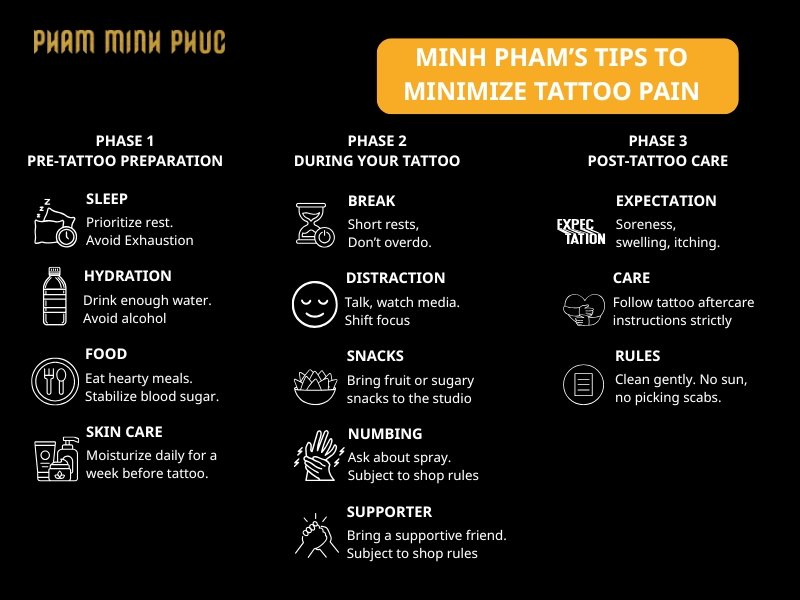
Phase 1: Pre-Tattoo Preparation
The success of your session is determined before you even enter the studio. You must prime your physiology to endure stress.
- Sleep: You must prioritize rest. Exhaustion depletes your nervous system, significantly lowering your tolerance for discomfort.
- Hydration: Drink plenty of water to ensure your skin is plump and accepts ink easily. However, you must avoid alcohol completely; it thins the blood and increases skin sensitivity, causing excessive bleeding that pushes ink out.
- Food: A fasting body is a fainting body. You need to eat a hearty meal to stabilize your blood sugar and provide sustained energy. Read my guide on what to eat before tattooing to choose the optimal fuel for your session.
- Skin Care: I recommend moisturizing the area daily for a week prior to your appointment. Hydrated skin is softer and easier to tattoo, reducing trauma and speeding up the process.
Phase 2: During Your Tattoo
Once the needle starts, your goal is to manage blood sugar maintenance and mental focus.
- Breaks: Request short breaks to reset your nerves if the pain becomes overwhelming. However, do not take too many; frequent stops cause the skin to swell and stiffen, making the resumption of work more painful.
- Distraction: Engaging your brain shifts focus away from the sensation. Feel free to talk to me or watch media on your phone to disassociate from the machine’s noise.
- Snacks: Bring fruit or sugary snacks to the studio. A quick sugar spike prevents lightheadedness and keeps your adrenaline response stable.
- Numbing: You can ask about numbing spray for sensitive areas. Note: Numbing products can change skin consistency, making it rubbery or spongy, so I prefer you ask me before applying anything yourself.
- Support: Bringing a supportive friend is generally acceptable, subject to shop rules, but they must remain calm to avoid distracting the artist.
Phase 3: Post-Tattoo Care
The acute pain stops the moment the needle lifts, but healing discomfort requires immediate attention.
- Expectation: Soreness, swelling, and itching are normal physiological reactions. The area will feel like a bad sunburn for several days.
- Care: You must follow instructions strictly to avoid infection, which causes far more pain than the tattoo itself. Consult my tattoo aftercare guide for the precise steps to ensure a flawless heal.
- Rules: Clean the area gently with antibacterial soap, avoid direct sun exposure, and never pick at scabs. Picking pulls ink out of the dermis and creates permanent scarring.
FAQs About Tattoo Pain
How Is The Tattoo Pain Chart Different For Men vs. Women?
Women generally tolerate pain better in fleshy areas like the hips, outer thighs, and glutes, while men tend to handle upper body placements such as the shoulders and upper back more easily.
This difference comes down to anatomy and biology. Women typically have higher subcutaneous fat distribution, which provides cushioning and reduces needle impact in lower-body areas. Men, on the other hand, often have thicker skin and denser muscle in the upper body, which can make long sessions in those zones more manageable.
However, men usually experience more intense pain in bony areas like the ribs and spine due to less fat cushioning, while women may feel increased sensitivity in areas like the inner arm or thigh, especially during certain hormonal phases.
Which Tattoo Placements Are Less Painful for Women?
Less painful placements for women include the outer thigh, hips, glutes, calves, outer bicep, and upper arm. These areas generally have more subcutaneous fat and muscle mass, which helps absorb the needle’s impact and reduce vibration. As a result, the sensation is typically described as a dull pressure or mild scratching rather than sharp pain. This makes them ideal for beginners or for longer tattoo sessions.
Do Fat People Feel Less Pain?
Not necessarily. While fat provides cushioning against bone vibration, loose skin can be more painful because it requires aggressive stretching to create a flat surface for the needle.
Does Tattoo Size Affect Pain Levels?
Yes, tattoo size directly affects pain levels because it determines how long your skin is exposed to continuous needle trauma. Larger designs require longer sessions, which increases inflammation, skin sensitivity, and overall fatigue as your body’s natural painkillers wear off over time. In contrast, smaller tattoos are completed quickly, making the discomfort more manageable.
Do Different Tattoo Styles Hurt More Than Others?
Yes, different tattoo styles can significantly affect pain levels depending on the technique and ink saturation required. Styles that involve heavy color packing or repeated passes over the same area, such as Realism, Tribal, or Blackwork, tend to be more painful due to increased skin trauma. On the other hand, styles like Fine Line or Dotwork are generally less intense because they require less saturation and fewer needle passes.
Can You Use Numbing Cream to Reduce Tattoo Pain?
Yes, numbing cream can help reduce tattoo pain, but you must consult your artist before applying it. Some numbing products alter the skin’s texture, making it feel rubbery or spongy, which can make it harder for the needle to deposit ink properly. This may affect both the tattooing process and the final healing result.
In professional practice, many artists prefer to control pain management themselves using approved numbing sprays during the session if needed. This ensures the skin remains in optimal condition for clean lines, proper saturation, and consistent healing.
What Is The Most Painful Tattoo You’ve Ever Done?
The palms of the hands and soles of the feet are technically the most painful. The nerve density is extremely high in these tactile areas, and the skin is tough, requiring more pressure to insert the ink.
Leveraging the pain chart transforms the tattoo experience from an unpredictable ordeal into a calculated biological process. By respecting the anatomical differences between fleshy zones like the outer thigh and high-nerve areas like the groin, the client minimizes the risk of tapping out mid-session. As a top rated San Antonio-based custom artist, I use this data to guide clients toward placements that balance artistic impact with physiological endurance. If the goal is a completed masterpiece rather than a traumatic memory, I am ready to plan the placement.