Tattoo styles encompass a diverse range of artistic techniques, from the bold black outlines of American Traditional to the intricate shading of Realism. Each genre follows specific rules regarding composition and longevity, where the choice between a heavy Blackwork piece and a delicate Fine Line design dictates how the ink will age within the dermis. Understanding these distinctions is critical because certain styles like Japanese Irezumi are engineered to flow with muscle groups, whereas others like Watercolor may lack the structural borders needed to prevent long-term fading.
This decision extends beyond visual preference to include practical factors such as anatomical placement, pain tolerance, and budget. For instance, Portraiture requires flat surfaces to avoid distortion, while Geometric patterns demand precision that can be ruined by skin stretching. In this guide, I, Minh Pham, will analyze the technical requirements of over 15 major styles to help you select the artwork that best fits your physiology and lifestyle in the article below.
Table of Contents
American Traditional (Old School)
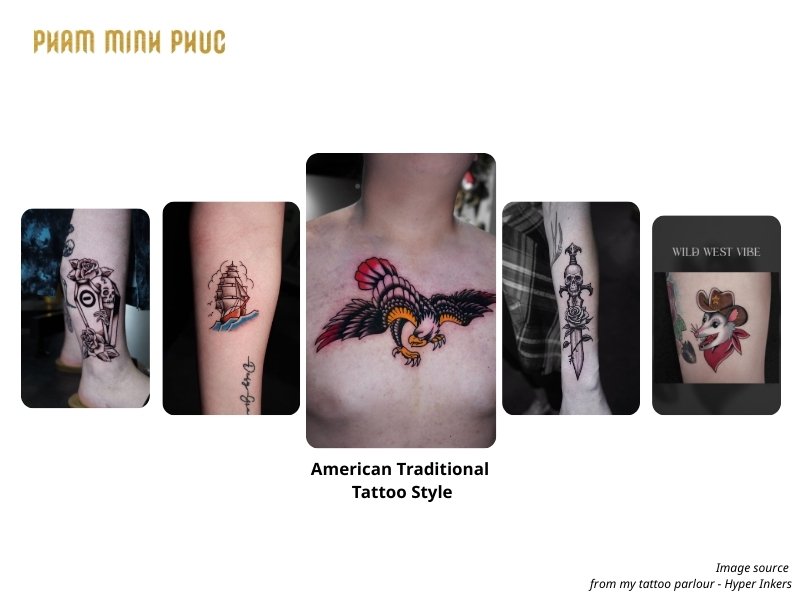
American Traditional Tattoo, also known as Old School, is defined by bold black outlines, a limited palette of primary colors (red, yellow, green, blue), and minimal shading. This style prioritizes high contrast and durability over realism. Originating from mid-20th-century maritime culture and popularized by artists like Sailor Jerry Collins, these designs follow the technical philosophy that “bold will hold.”
American Traditional is suitable for clients who prioritize longevity and want a tattoo that remains legible for 40+ years. It works effectively on all skin tones because the heavy black outlines create strong contrast against melanin. It is also the standard choice for “sticker sleeve” collectors who accumulate individual, standalone designs over time. In terms of placement, this style is incredibly versatile, looking excellent as standalone pieces on the forearm, calf, or bicep, or pieced together into a full “patchwork” sleeve.
Common imagery in this style includes nautical symbols like anchors, swallows, and sailing ships. Other frequent motifs are eagles, panthers, daggers, roses, and pin-up girls, all rendered with a flat, 2D appearance that avoids complex gradients.
Japanese Traditional (Irezumi)
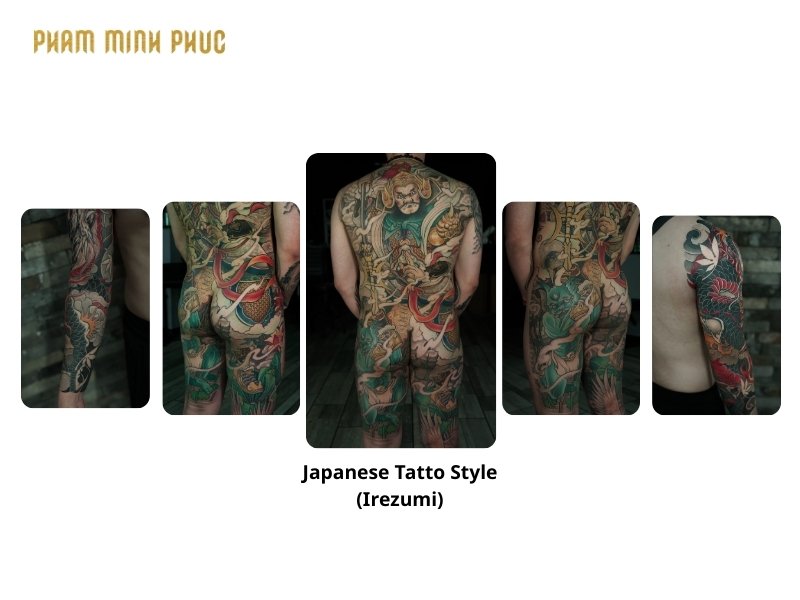
Japanese Traditional tattoo style (Irezumi) is a historical style that uses large-scale compositions to cover the entire body, featuring symbolic motifs set against a background of wind bars, waves, or clouds. Unlike Western “sticker” tattoos, Irezumi focuses on anatomical flow and movement. It relies on high-contrast black backgrounds (Gakubori) to frame the main subject.
Japanese Traditional style is suitable for clients ready for a significant commitment in time and budget. This style is designed for full sleeves, back pieces, or bodysuits rather than small, isolated tattoos. It serves well for clients viewing tattooing as a protective layer or rite of passage due to the extensive surface area covered. Due to its reliance on flow and muscle structure, this style is best placed on large, continuous canvases like the full back, chest panels, or full arm/leg sleeves.
Common motifs draw from folklore and mythology, featuring Dragons (wisdom), Koi fish (perseverance), and Phoenixes (rebirth). These figures are typically paired with floral elements like cherry blossoms or peonies and elemental fillers like water and wind to connect the body panels.
View my Japanese traditional tattoo style gallery to admire real client work and get inspired for your piece.
Tribal
Tribal tattoos refer to designs rooted in the indigenous traditions of cultures such as Polynesian, Maori, Samoan, and Aztec. Historically, these tattoos served as rites of passage, status symbols, or protection. Visually, they rely on solid black ink arranged in specific patterns that flow with the body’s musculature, avoiding shading or gray wash.
Tribal style is suitable for clients seeking a deep connection to heritage or warrior aesthetics. I respectfully ask clients to be considerate when requesting certain styles as some styles transcend aesthetics and art and into traditional, familial, or cultural meaning; specific patterns (like Ta Moko) often belong to specific families. The bold, solid black nature makes Tribal an excellent choice for darker skin tones or for accentuating large muscle groups like shoulder, upper arm, chest, or calf.
Common imagery consists of interlocking geometric patterns, spearheads, shark teeth, and repetitive waves. Modern “Neo-Tribal” designs (popular in the 90s) mimic these flows using sharp, abstract spikes without the specific cultural meaning.
Blackwork
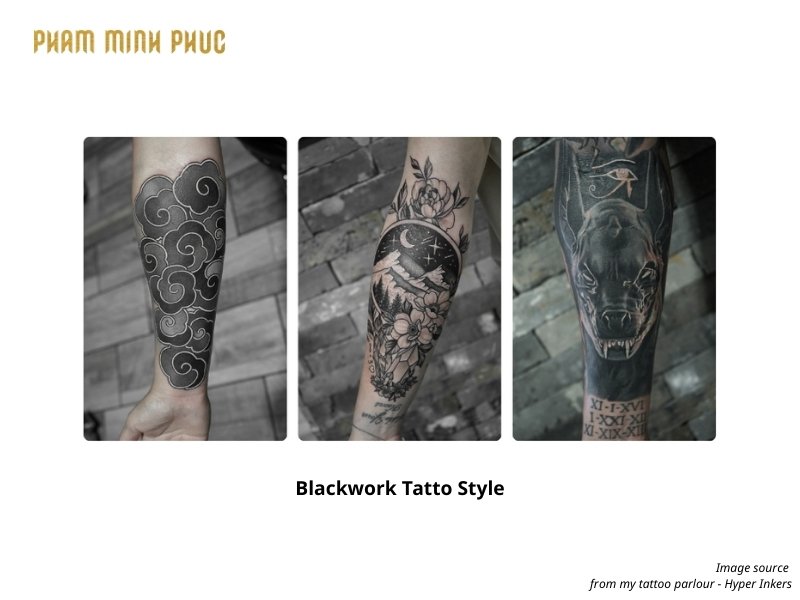
Blackwork tattoo style is a broad modern category encompassing any tattoo that relies exclusively on solid black ink and negative space. Unlike Tribal, Blackwork is not bound by indigenous tradition; it focuses on high contrast, heavy saturation, and graphic design elements. It ranges from delicate ornamental patterns to extreme “Blackout” coverage.
Blackwork style is suitable for clients wanting a bold, graphic look or those needing heavy cover-ups. Because it uses dense black pigment (“color packing”), it is the most effective style for hiding old, unwanted tattoos completely. It requires high pain tolerance due to the intense saturation needed to prevent patchiness. Large-scale Blackwork makes a powerful statement on the entire arm (sleeve), lower leg, or back, effectively utilizing the body’s natural curves to frame the heavy contrast.
Common imagery includes solid blackout sleeves (covering large areas entirely in black), heavy ornamental mandalas, abstract geometric blocks, and “sigil” style lines. It emphasizes the contrast between the un-inked skin and the heavy black pigment.
Realism
Realism tattoo style is a technically demanding style aimed at replicating imagery as it appears in real life, utilizing fine shading and contrast rather than hard outlines. Artists use a “mapping” technique to build depth layer by layer, creating a 3D effect. It relies heavily on the quality of the ink and the artist’s ability to render light and shadow smoothly.
Realism style is suitable for clients who want their skin to look like a canvas for fine art or photography. It works best on lighter skin tones where subtle gray shading remains distinct. Clients must be diligent with sun protection, as the lack of bold outlines means UV damage can easily blur the soft edges over time. This style strictly requires flat, low-movement surfaces like the inner forearm, outer thigh, or calf to prevent facial features or straight lines from warping
Common imagery spans from high-fidelity portraits and movie scenes to realistic wildlife (lions, wolves) and nature. It essentially turns a photo or a realistic painting into a permanent mark on the skin.
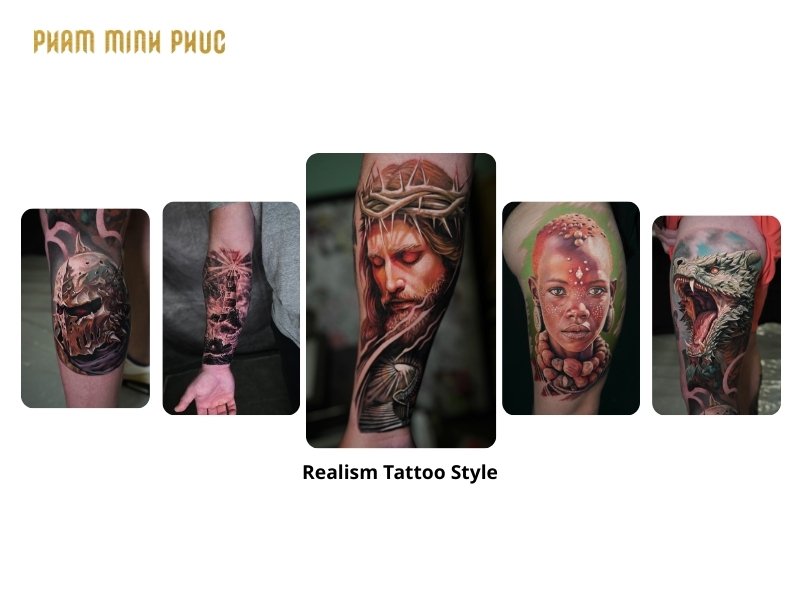
View my Realism tattoo style gallery to admire photo-realistic portraits and depth-driven compositions.
Black and Grey
Black and Grey tattoo style is a style using only black ink diluted into various “gray washes” to create dimension and smooth gradients. Originating from Chicano prison culture, it differs from Blackwork by relying on the value (lightness/darkness) of the ink rather than solid blocking. It focuses on smoothness and contrast.
Black and Grey is suitable for clients with lower pain tolerance, as the shading process causes less skin trauma than solid color packing. It heals faster than color tattoos and works well on most skin tones. This style offers a timeless, classic aesthetic that integrates easily with other tattoos. Black and Grey style adapts well to almost any placement but shines particularly on the inner bicep, forearm, or ribs where the smooth gradients can be protected from excessive sun exposure.
Common imagery includes religious icons like the Virgin Mary, crosses, and praying hands. It is also the standard for Chicano-style motifs such as clowns, script, pocket watches, and statues, as well as realistic roses that use shading to define the petals.
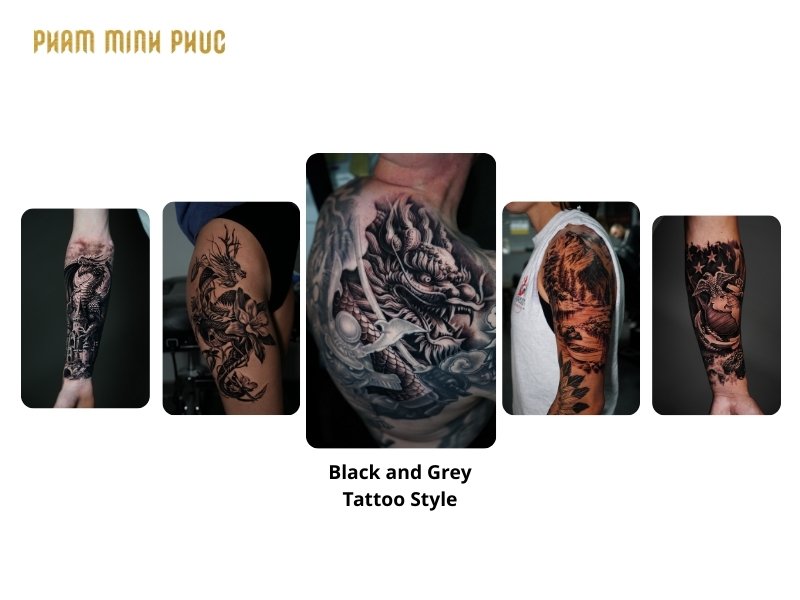
View my Black and Grey tattoo style gallery to admire realistic depth created through soft gradients and contrast.
Portrait
Portraiture tattoo style is a sub-genre of Realism focused strictly on capturing the likeness and character of a human or animal face. Success depends on the artist’s mastery of anatomy and light mapping. Precision is critical; a single millimeter of error in the eyes or mouth can ruin the subject’s likeness.
Portraiture is suitable for commemorating a loved one, pet, or idol. This style is restricted to clients who can provide high-resolution reference photos. A blurry source image will result in a blurry tattoo. Clients should seek a specialist, as generalist artists often struggle with the nuances of facial structure. Absolute stability is required for the likeness to remain accurate, making the outer bicep, thigh, or calf the only recommended placements to avoid distortion from skin stretching.
Common imagery consists of specific individuals: family members, pets, historical figures, or celebrities. The objective is to capture the specific emotion and spirit of the subject, not just a generic face.
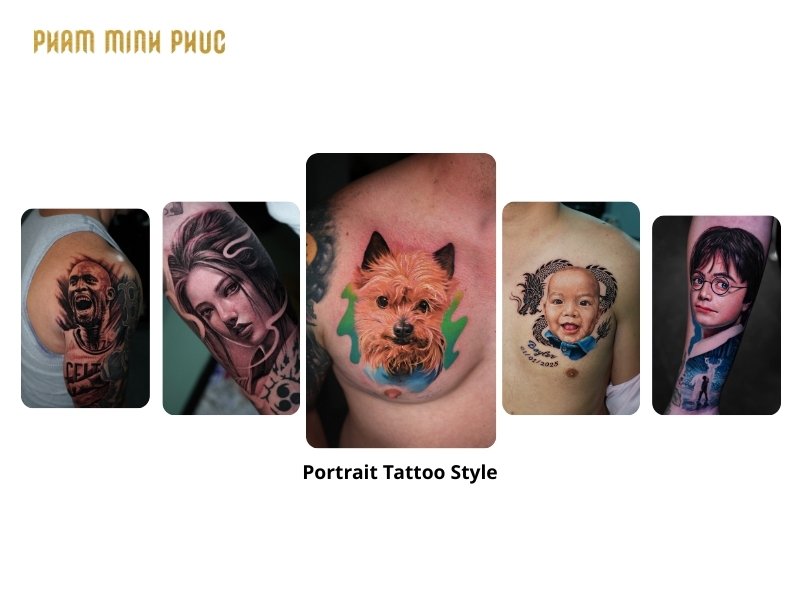
View my Portrait tattoo style gallery to admire realistic human and pet portraits crafted with technical precision.
Surrealism
Surrealism tattoo style draws from 20th-century art, combining realistic imagery in illogical or dream-like juxtapositions. These designs blend disparate elements to challenge reality, requiring the technical skills of a realism artist combined with the imaginative composition of an illustrator.
Surrealism style is suitable for creative clients desiring unique, custom artwork. It is ideal for those tired of standard traditional motifs who want to express complex abstract ideas or personal dreamscapes. These complex compositions need room to breathe, making medium-to-large canvases like the thigh, shoulder blade, or upper arm ideal for capturing the intricate details.
Common imagery includes melting objects (inspired by Salvador Dalí), morphing faces blending into landscapes, floating islands, and the combination of organic biology with mechanical objects. The visuals are often bizarre, unsettling, or thought-provoking.
Neo-Traditional
Neo-Traditional tattoo style is an evolution of American Traditional that retains bold outlines but introduces varying line weights, a broader color palette, and illustrative depth. Unlike the flat appearance of Old School, Neo-Traditional adds shading and dimension, often influenced by Art Nouveau aesthetics.
Neo-Traditional style is suitable for clients who want the durability of Traditional tattoos but desire more detail and color depth. It creates a balance between artistic freedom and longevity, using solid outlines to hold the design structure while allowing for complex interior details. The decorative nature of this style frames the body beautifully, making it a top choice for the sternum, thigh, or shin, as well as full sleeves.
Common imagery features animals adorned with jewelry or pearls, stylized female faces (“goddesses”), daggers piercing floral arrangements, and designs framed by decorative filigree or Art Nouveau curves.
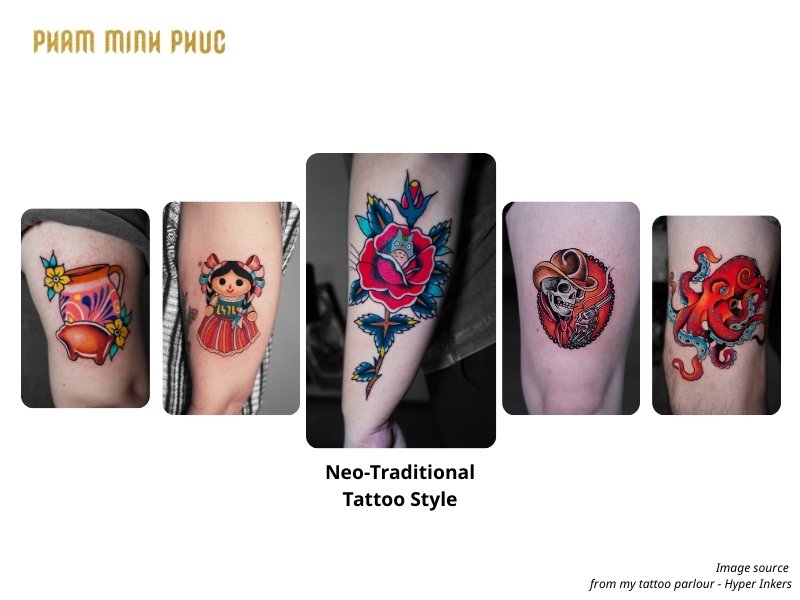
New School
New School tattoo style is a style from the 1990s characterized by exaggerated caricatures, graffiti aesthetics, and neon color palettes. It rejects realism for distorted perspectives, bubble letters, and cartoonish proportions to create a dynamic, 3D effect.
New School style is suitable for pop culture fans and clients wanting ink that visually “pops.” This style performs best on pale skin to display neon colors vividly; on tanned skin, bright yellows and greens may lack contrast. The bulging, 3D perspective of New School works effectively on rounded muscle groups like the outer shoulder, calf, or elbow, enhancing the cartoonish volume.
Common imagery involves exaggerated cartoon characters, graffiti lettering, video game assets, and anthropomorphic animals with oversized eyes. Designs often use forced perspective to make the image appear to bulge out of the skin.
Illustrative
Illustrative is a broad term for tattoos that resemble drawings on paper, using techniques like cross-hatching, stippling, or sketching. Unlike Realism, this style emphasizes the “artist’s hand” and visible stroke marks, prioritizing composition over photographic accuracy.
Illustrative is suitable for fans of fine art, etching, or engraving styles. It is effective for storytelling where the artistic style is more important than reality. It offers a custom feel, appearing like a direct transfer from a sketchbook. The intricate linework of Illustrative pieces looks stunning on the forearm, ribs, or shin, where the fine details can be easily admired.
Common imagery includes Tarot cards, botanical illustrations resembling scientific drawings, woodcut-style etchings, and storybook scenes. The line work often gives the piece a whimsical or vintage engraving aesthetic.
Watercolor
Watercolor tattoos simulate the fluid look of watercolor paint using splatters, drips, and soft gradients without black outlines. This technique creates a painterly effect with pastel tones and color bleeds.
Watercolor style is suitable for clients desiring a soft, artistic look who accept faster fading. Without a black “skeleton” to hold the ink, colors spread and lighten more quickly than lined styles. It is best for fair skin where translucent colors remain visible. Water color tattoo should be placed on low-friction areas protected from the sun, such as the ribs, shoulder blade, or inner arm, to prolong color vibrancy because the pigment is delicate.
Common imagery includes hummingbirds, butterflies, abstract color splashes, and flowers without outlines. Galaxy themes are also frequent, using the technique to blend blues and purples into nebula effects.
Trash Polka
Trash Polka is a collage style using strictly black and red ink to mix realism with chaotic abstract elements. Originating from the Buena Vista Tattoo Club, it juxtaposes detailed realism with graphic smears and typography.
Trash Polka is suitable for clients wanting a large-scale, aggressive statement piece. This style requires space (chest, back, or full arm) to prevent the chaotic elements from becoming illegible. It is not functional for small designs.
Common imagery involves realistic skulls, crows, or portraits overlaid with red paint strokes, abstract splatters, typewriter fonts, and geometric black blocks. The contrast between order (realism) and chaos (trash) is the defining feature.
Geometric
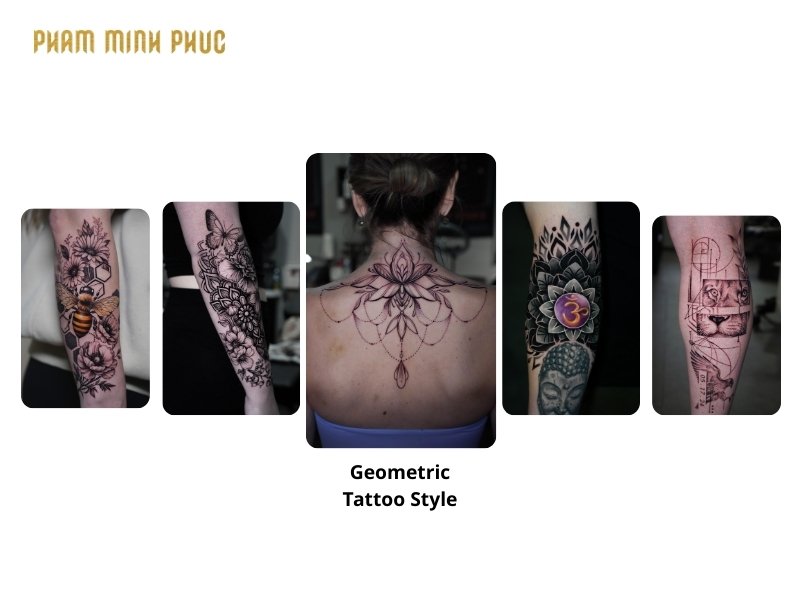
Geometric tattoos use mathematical precision and symmetry to create patterns with circles, triangles, and polygons. This style often incorporates Sacred Geometry or mandalas, representing balance and order.
Geometric is suitable for clients valuing precision and symbolism. It works best on flat, symmetrical body parts (back, chest, forearm) to avoid distortion from muscle movement. It requires an artist with steady hands for perfect straight lines.
Common imagery includes Mandalas, Metatron’s Cube, the Flower of Life, and low-poly animals (shapes forming an animal). These are often combined with Dotwork for shading.
Dotwork
Dotwork (Pointillism) builds images using thousands of individual dots rather than solid shading. Varying the dot density creates depth and gradient. This technique is often paired with Geometric styles.
Dotwork is suitable for clients with lower pain tolerance, as stippling is less abrasive than block shading. It ages well; even if individual dots fade, the overall image retains readability and texture. The texture of Dotwork flows excellently over joints, making it a popular choice for knees and elbows, as well as the sternum and wrist.
Common imagery includes Mandalas, stippled landscapes, and shading for geometric patterns. It is also used for “soft” shading in religious symbols or portraits to create a grainy texture.
Fine Line
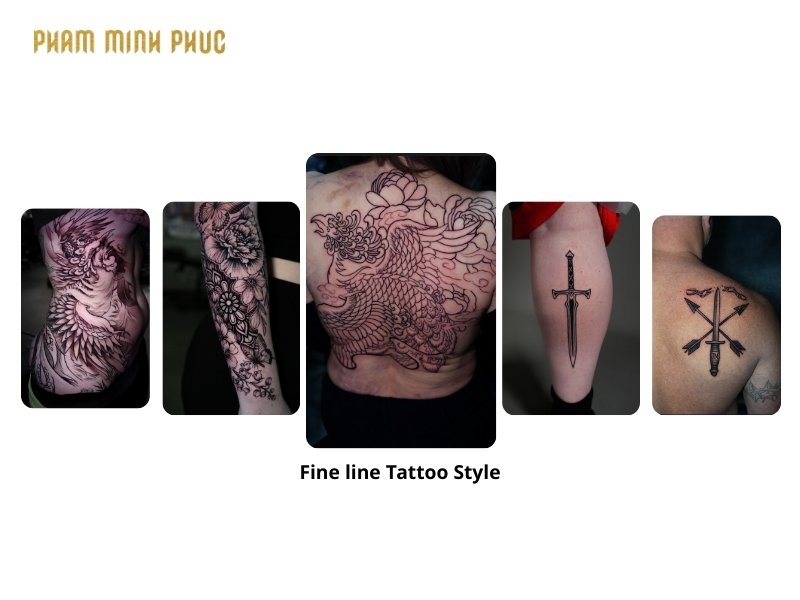
Fine Line tattooing uses single needles (1RL or 3RL) to create delicate, thin designs resembling technical pen drawings. This style is standard for micro tattoos and minimalism.
Fine Line is suitable for first-timers or professionals needing discreet tattoos. Clients must know that fine lines are fragile; they are not recommended for high-friction areas like fingers or feet where they fade quickly. These delicate designs require low-friction placement to hold their crispness, making the inner wrist, forearm, or ankle the most common choices.
Common imagery includes micro-flowers, cursive script, tiny pets, constellations, and minimalist line drawings. The focus is on simplicity and elegance.
Stick and Poke
Stick and Poke (Hand-poked) tattoos are created manually without a machine, pushing ink into the skin dot by dot. This results in a raw, organic look that is distinct from machine work.
Stick and Poke is suitable for clients wanting a ritualistic or “DIY” aesthetic. It heals quickly and is often less painful, making it appropriate for small, intimate designs. Given their usually small and intimate nature, these tattoos fit perfectly on the fingers, behind the ear, or the ankle.
Common imagery includes simple symbols, runes, tiny doodles, minimalist lines, and basic geometric shapes. The aesthetic relies on the handmade, imperfect feel.
Biomechanical
Biomechanical tattoos use hyper-realistic shading to create the illusion of skin ripped open to reveal robotic parts. Popularized by H.R. Giger, the design flows with musculature to make the mechanical parts appear functional.
Biomechanical tattoo style is suitable for sci-fi fans and clients wanting to accentuate muscle definition. It requires a large canvas (sleeves, legs) to achieve the necessary 3D depth. This style must be placed directly over major muscle groups like the bicep, calf, or quadriceps to sell the illusion of machinery replacing anatomy.
Common imagery focuses on ripped skin, gears, metal pistons, hydraulic tubes, and alien organic matter. The goal is to blend biology with machinery.
How to Choose the Right Tattoo Style for You?
Selecting a style requires balancing five critical practical factors: aesthetic preference, skin type, placement, size, and budget. Not every design works in every style or on every part of the body. A complex landscape cannot fit on a finger, and a geometric pattern requires a flat surface to avoid distortion.
You must evaluate these constraints before finalizing your decision:
- Placement: The body’s curvature dictates the style. Geometric and Realism tattoos require flat surfaces (like the forearm, back, or thigh) to prevent the image from warping. Japanese and Tribal styles are designed to wrap around muscles and look excellent on curved areas like shoulders or calves.
- Tattoo Size: Detail requires space. You cannot fit a photorealistic portrait into a 2-inch square; it will turn into a blob. If you want a Small (2×2) tattoo, you are limited to Fine Line, Minimalist, or simple symbols. If you want Realism or Japanese, you must commit to a large canvas.
- Budget: Complexity equals cost. Styles that are labor-intensive, like Dotwork, Realism, or color-packed Neo-Traditional, take significantly longer to execute and will cost more. American Traditional or simple Line Art are generally faster and more budget-friendly.
- Skin Type: Fine Line and Watercolor may fade faster on darker skin tones or oily skin types. Bold Traditional or Blackwork offers the best longevity for all skin types.
- Consultation: Show your reference image to me or your artist and ask, “Which style captures this best within my budget and size constraints?”
Does Minh Pham Have Signature Tattoo Style?
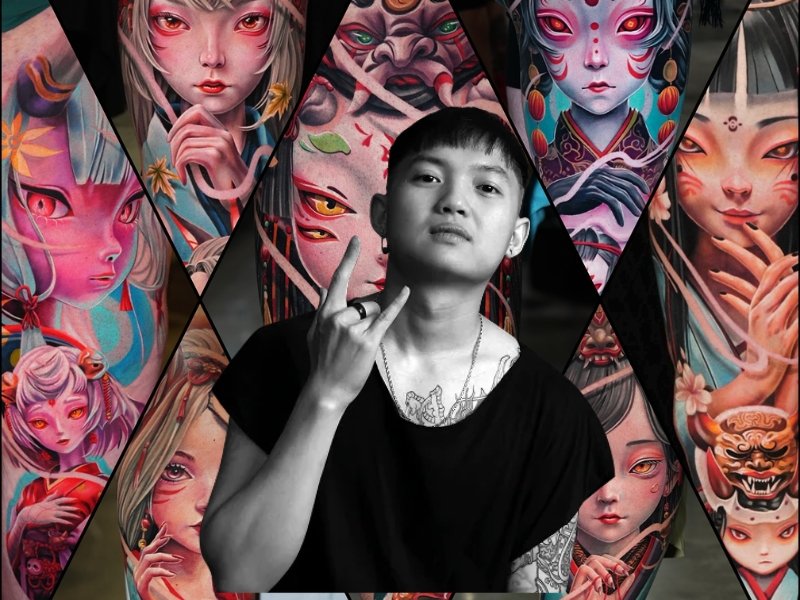
I specialize in Black and Grey, Realism, and Color. My extensive portfolio is built on years of executing complex, large-scale projects that demand absolute technical precision and artistic depth.
My mastery is further validated by over 40 international awards, many of which were secured using my signature “Evil Doll” style. This signature aesthetic, which I consistently execute at major competitions, has established me as an internationally recognized talent. As one of the top rated tattoo artists in San Antonio, I bring this award-winning pedigree to every session, ensuring you receive world-class art.
FAQs about Tattoo Style
Which Tattoo Style Hurts The Most?
Styles requiring heavy saturation and repetitive layering, such as Tribal, Biomechanical, and full-color Realism, cause the most pain. These force the artist to pack ink densely, traversing the same area multiple times. Styles using “negative space” like Dotwork, Fine Line, or Black and Grey are generally less painful due to reduced skin trauma.
Which Tattoo Style Ages The Best?
The tattoo styles that age the best are American Traditional, Neo-Traditional, Japanese (Irezumi), Blackwork, Tribal, Black and Gray, and Dotwork. These styles share a critical technical advantage: they utilize bold black outlines, deep saturation, or high contrast (negative space), which allows the design to remain readable even as ink naturally migrates and fades over decades. making them ideal choices for tattoos that age well.
Which Tattoo Style Lasts The Longest Without Fading?
Black and grey tattoo is widely recognized as the longest-lasting tattoo style. Thanks to its reliance on solid black ink, smooth shading, and controlled contrast, black and grey tattoos age more gracefully than color tattoos and can maintain depth, structure, and readability for 10+ years when executed correctly. Longevity depends heavily on two factors: professional technique and high-quality ink. Proper saturation, correct needle depth, and balanced gradients prevent premature fading or blurring over time.
Throughout my career, I’ve had clients return after five years with black and grey tattoos that remain sharp, clean, and well-defined. This long-term result proves that choosing an experienced artist matters. By working with me, Minh Pham, you are investing in technical precision and artistry that ensures your black and grey tattoo stays bold, timeless, and visually strong for years to come.
Is “Ignorant Style” A Real Thing?
Yes, “Ignorant Style” is a contemporary movement rejecting technical perfection for a crude, graffiti-like aesthetic. It resembles doodles or prison tattoos, characterized by shaky or simple linework. It serves as an artistic statement prioritizing humor and raw expression over the polished look of modern tattooing.
Can You Mix Tattoo Styles?
Yes, mixing styles is possible but requires planning for visual cohesion. A “Patchwork Sleeve” mixes styles (e.g., Traditional next to Blackwork) by using skin spacing as a border. A “Fusion” piece blends styles (e.g., Realism with Geometric) in a single image. The key is matching saturation levels so one tattoo does not overpower the other.
See more:
In this guide, I helped you navigate the technical differences between major tattoo styles, distinguishing between the durability of Old School and the delicate nature of Fine Line. You now understand that selecting a genre requires balancing aesthetic desire with anatomical placement and skin type to ensure the artwork ages gracefully. As a San Antonio-based custom artist, I specialize in adapting these artistic rules to create a piece that fits your body perfectly. If you are ready to define your unique look, I am here to bring your vision to life.