Tattoo pricing is calculated using three primary models: Hourly Rate (standard for custom work, ranging from $80 to over $500), Flat Rate (for pre-determined designs), and a non-negotiable Shop Minimum (typically $60–$100 in San Antonio) to cover sterile setup costs. The final cost is never arbitrary; it fluctuates significantly based on key variables such as artist experience, anatomical placement difficulty, and design complexity. For instance, a medium-sized tattoo on a standard placement like the forearm typically costs between $150 and $450, while intricate full sleeves can exceed $4,000.
When budgeting, clients must also factor in additional fees such as deposits, custom design charges, and aftercare supplies. To provide financial clarity, professional studios break down costs by size tiers and anatomical zones, where difficult areas like ribs or necks incur premium surcharges due to increased technical demands. Ultimately, optimization strategies like attending Flash Days or choosing standard placements can help manage expenses without compromising quality.
In this article, I – Minh Pham, will break down the mathematics of tattoo pricing, guiding you through the factors influencing costs and providing concrete estimates based on placement and size. I will share a transparent real-world cost example from my studio, explain the standard payment process, and offer expert tips on how to optimize your budget for professional-grade ink.

Table of Contents
How Is Tattoo Pricing Calculated?
Tattoo pricing is calculated using three primary business models: Hourly Rate, Flat Rate, and Shop Minimum, which professional studios utilize to determine the final cost. Understanding which model an artist applies is the first step to budgeting accurately, as it often depends on whether you are getting a pre-drawn design or a custom-fit masterpiece.
- Hourly Rate: This is the industry standard for custom tattoos and large-scale projects like those I specialize in (sleeves, back pieces, realism), with rates typically ranging from $80 to over $500 per hour. You pay for the artist’s labor, usually tracked from the moment the needle touches the skin until the bandage is applied.
- Flat Rate (Piece Price): This model is most common for flash tattoos or pre-determined designs where the size and complexity are fixed variables. The artist quotes a single, all-inclusive price upfront, eliminating any guesswork about the final bill.
- Shop Minimum: This is the non-negotiable base fee (typically $60–$100 in San Antonio, Texas) required to cover the fixed operational costs. Even a single dot requires the same medical-grade sterilization, single-use needles, ink caps, and station setup as a full portrait, necessitating this floor price.
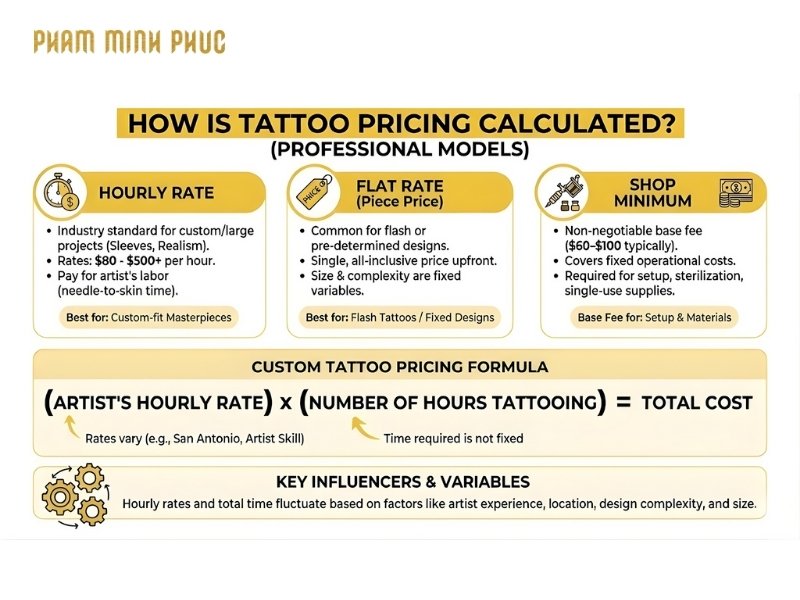
Custom tattoo pricing generally follows a straightforward formula used by professional artists:
Total Cost = (Artist’s Hourly Rate) × (Number of Hours Tattooing)
The specific variables, such as the hourly rate in San Antonio and the total time required, are not fixed and fluctuate significantly based on several key influencers. To understand why a tattoo might take 2 hours for one artist but 4 hours for another, or why rates vary across town, it is essential to examine the specific factors that influence tattoo costs detailed below.
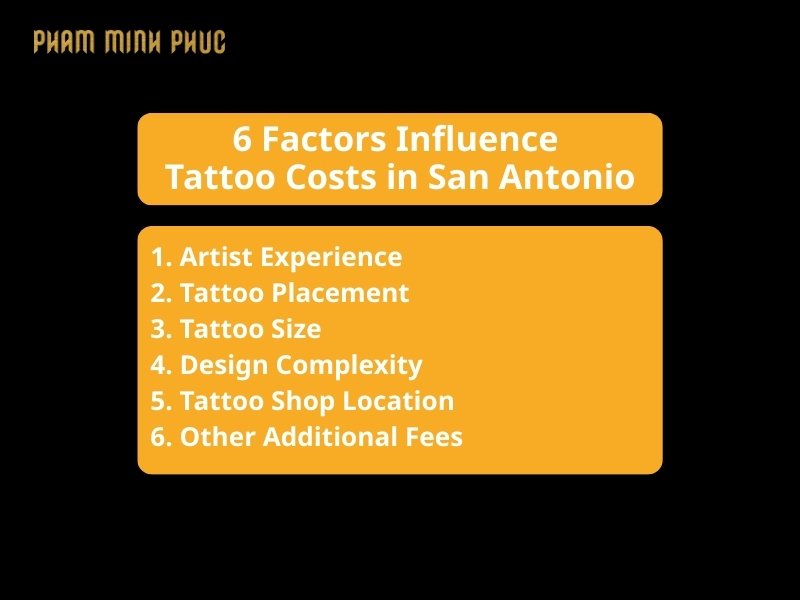
What Factors Influence Tattoo Costs in San Antonio?
The final price tag on a tattoo is never arbitrary; it is a mathematical reflection of the resources, skill, and risk management required to execute the piece safely. In the San Antonio market, these costs fluctuate based on specific variables that affect the artist’s workflow and the studio’s operational standards.
Artist Experience
Artist experience is the single most significant driver of cost, as you are paying for the artist’s years of training, not just the hours spent in the chair. A seasoned professional might charge more per hour but can often complete a design significantly faster than a novice, ultimately balancing the total investment.
- Apprentice: Rates typically range from $80 to $100 per hour. These are artists in training who are actively building their portfolios. While they offer an affordable entry point for clients, sessions often require more time as they navigate the learning curve, and their technical scope is generally best suited for simpler, less risky designs.
- Professional Artist: Market rates generally fall between $120 and $250 per hour. These are established artists with solid portfolios who can execute clean lines and smooth shading efficiently. For transparency, my personal rate falls within this bracket, typically ranging from $150 to $200 per hour depending on the project’s complexity.
- Master/Specialist: These industry icons command rates from $250 to over $500 per hour. They are high-demand artists with decades of experience and global awards. While their hourly rate is significantly higher, a Master often works 3x faster than an apprentice, meaning the total cost effectively pays for superior longevity and artistry.
Tattoo Placement
Anatomical difficulty dictates the price because different body parts present unique challenges for stretching skin and planting ink. In my experience, difficult tattoo placements often incur a 10% to 25% increase in cost due to the added complexity and the slower working pace required to ensure client comfort and precise lines.
- Easily Accessible Placements (e.g., Forearm, Bicep, Calf): These areas are the standard canvas because the skin is firm and easy to stretch. A small, simple design here typically costs $100 to $250, while more complex, medium-sized pieces generally range from $250 to $450.
- Moderately Difficult Placements (e.g., Shoulder, Back, Chest): These larger canvases are ideal for extensive work but require more physical maneuvering. Costs typically start around $300 for a simple standalone piece, while a full back or chest panel can range from $1,000 to $5,000+ depending on the saturation and detail.
- Difficult or Sensitive Placements (e.g., Ribs, Sternum, Neck, Feet, Hands): These areas carry a premium because they are technically demanding and physically painful for the client. You should expect prices to start at $150 to $350 for even small designs, with costs increasing significantly with size and intricacy due to the high risk and precision required.
Tattoo Size
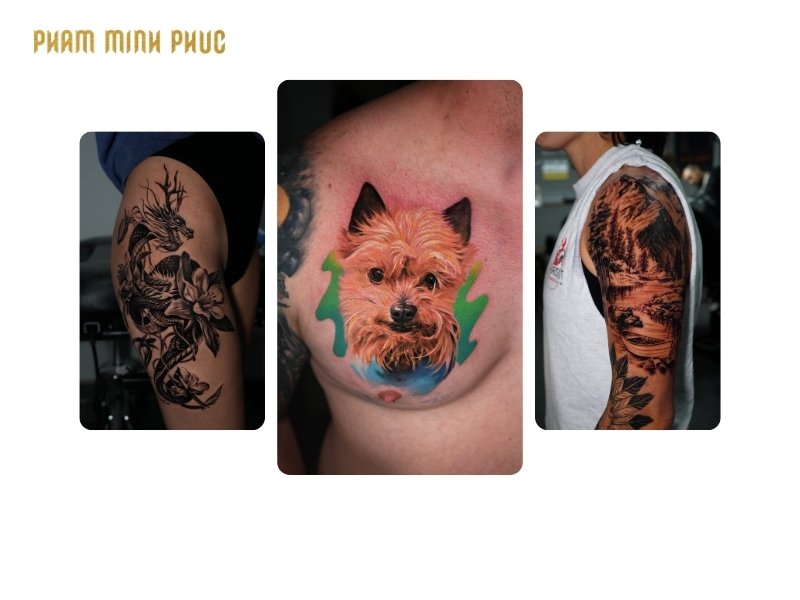
Tattoo size correlates directly with time and material consumption, serving as a base multiplier for the final quote. From my perspective, artists often categorize projects into four distinct size tiers to provide initial estimates.
- Micro or Tiny Tattoos (Under 2 inches/5 cm): These usually start at the shop minimum of $60 to $100. Even though the design is minute, I still need to perform the full sterilization and setup process, which is why the cost reflects the service rather than just the ink time.
- Small Tattoos (2 to 4 inches/5 to 10 cm): Prices typically range from $60 to $250. These pieces are often completed in a single short sitting, making them an accessible entry point for clients getting their first ink.
- Medium Tattoos (4 to 6 inches/10 to 15 cm): Costs generally fall between $150 to $450. This is a common size for custom pieces on the forearm or calf, allowing enough room for detail without requiring a full-day session.
- Large Tattoos (Full Sleeve, Back Piece): These are substantial commitments generally priced hourly, with total project costs ranging from $500 to $4,000+. Because these projects span multiple sessions, the final price depends heavily on the density of the design and the total hours accumulated.
If you want to better understand how different tattoo size categories impact both design detail and overall cost, take a closer look at my complete guide.
Design Complexity
Tattoo intricacy, often influenced by different tattoo styles, increases billable hours because detailed art requires more precision and technical steps. A simple outline is quick for me to execute, whereas custom designs include “invisible costs” – the hours I spend drafting your unique piece before you even arrive at the studio.
- Simple Outline or Script: These designs are straightforward to execute and generally cost between $60 and $250.
- Detailed Black and Grey: Projects requiring shading and depth typically range from $250 to $1,500 depending on the overall size.
- Full-Color or Photorealistic Designs: Due to the advanced technique required, these pieces often start at $500 and can exceed $3,000 for larger, complex works.
Tattoo Shop Location
Overhead costs heavily impact pricing, as legitimate studios must factor in rent, insurance, and medical supplies. Studios located in prime areas of San Antonio or major cities like Los Angeles face higher rent and operational costs, which are naturally reflected in their rates. Furthermore, a legitimate studio invests heavily in hospital-grade sanitation and licensing, which “scratchers” (home artists) ignore to offer dangerously low prices.
Other Additional Fees
When calculating the total investment for your tattoo, it is essential to look beyond the quote for the artwork itself. In my professional experience, first-time clients often overlook the necessary ancillary costs that cover the preparation, comfort, and healing phases of the process. I strongly recommend factoring the following standard expenses into your initial budget to avoid any surprises at the checkout counter.
- Appointment Deposit: Nearly all studios, including mine, require a non-refundable deposit ($60 to $200) to secure your time slot; this is credited toward the final cost but is forfeited if you cancel last minute.
- Custom Design Fees: For highly complex concepts, I may charge a separate fee ($60 to $300+) to cover the hours spent researching and drafting the artwork before our session.
- Numbing Cream: If you have a low pain threshold, optional numbing agents can be applied, but this service often carries an extra charge for the product and the waiting time.
- Aftercare Products: Proper healing is crucial for longevity, so budget $10 to $30 for essential supplies like antibacterial soap and specialized tattoo ointments.
- Artist Tip: While voluntary, a gratuity of 15% to 25% is customary in the industry and should be prepared in cash to show appreciation for the artist’s effort and care.
Estimating Tattoo Pricing Based on Placement and Artist Expertise
To give you a realistic financial expectation, I have broken down the costs based on anatomical difficulty below. Different body parts require varying levels of technical skill and time management to stretch the skin and pack the ink correctly.
| Placement | Difficulty Level | Apprentice Estimate | Professional Estimate | Master/Specialist Estimate |
| Arm/Leg | Low (Standard) | $150 – $250 | $300 – $450 | $500 – $800+ |
| Chest/Back | Medium | $200 – $300 | $400 – $600 | $700 – $1,000+ |
| Ribs/Sternum | High (Painful) | $250 – $350 | $500 – $700 | $800 – $1,200+ |
| Hands/Neck | Very High (Technical) | N/A (Often restricted) | $350 – $550 | $600 – $900+ |
Estimating Tattoo Pricing Based on Size and Artist Expertise
Size serves as the baseline multiplier for time, significantly impacting the final quote. The table below illustrates how the scale of your design interacts with the artist’s experience level to determine the price range in the current market.
| Tattoo Size | Apprentice Rates | Professional Rates | Master Rates |
| Tiny (< 2 inches) | $60 – $80 (Minimum) | $80 – $100 (Minimum) | $150 – $200 (Minimum) |
| Small (2–4 inches) | $100 – $200 | $200 – $400 | $400 – $600 |
| Medium (4–6 inches) | $250 – $400 | $450 – $700 | $700 – $1,200 |
| Large (Half Sleeve) | $600 – $1,000 | $1,200 – $2,000 | $2,500 – $4,000 |
| Full Sleeve/Back | $1,500 – $3,000 | $3,500 – $6,000 | $8,000 – $15,000+ |
Tattoo Cost Example by Style, Provided by Minh Pham
I want to share a transparent breakdown of a typical custom project at my studio to help you visualize the math behind the quote. This example demonstrates that you are paying for the entire process – from the initial sketch to the final wipe – not just the needle time.
Project Example: Black & Grey Realism Portrait (Forearm Placement). Artist Level: Senior Professional ($200/hour). Process:
- Consultation & Design: 1 Hour (Included in deposit).
- Stenciling & Setup: 30 Minutes.
- Tattooing Time: 4.5 Hours (Detailed shading and texture).
- Final Cleaning & Bandaging: 15 Minutes.
Total Billable Time: ~ 5 Hours. Calculation: 200×5=$1,000. Total Cost: $1,000 (plus tip and aftercare). Note: A generic “flat vector” version of this same size might only take 2 hours ($400), proving that style dictates cost as much as size.

If you want a personalized consultation on tattoo pricing along with a custom design tailored to your ideas, you can book an appointment with me, recognized as one of the best tattoo artist in San Antonio. I will help you estimate the exact cost based on your placement, size, and design complexity before the session begins. This ensures full transparency and helps you plan your budget with confidence.
The Tattoo Payment Process
The standard payment structure separates the financial commitment into two distinct stages: booking and completion. This split workflow ensures that the artist is compensated for the preliminary design work while allowing the client to spread the cost over time rather than paying the full amount upfront.
- Upfront Deposit: To book your appointment, you will pay a non-refundable deposit (typically $50–$100), which is immediately credited toward the final cost of your tattoo.
- Final Balance: On the day of your appointment, once the session is finished and you are satisfied with the work, you will pay the remaining balance.
Payment Methods: Most professional studios accept major credit cards, debit cards, and cash to accommodate client preferences.
Payment Example: To make this process clear, here is how the math works for a standard session. If your total quoted cost is $550 and you paid a $100 deposit online to secure the date:
$550 (Total Session Cost)−$100 (Deposit Paid)=$450 (Due on Appointment Day)
You would simply pay the remaining $450 to the studio upon completion, plus any tip you wish to leave for your artist.
How to Optimize a Tattoo’s Cost?
If you are working with a strict budget, you can manage your expenses without sacrificing the safety or quality of your artwork. By being strategic with your design choices and timing, you can secure professional-grade ink at a more accessible price point.
- Attend Flash Days: Look for events such as Friday the 13th, where studios offer pre-drawn designs at discounted flat rates.
- Choose Standard Placements: Stick to arms or legs to avoid “difficult placement” surcharges associated with ribs or necks.
- Simplify the Design: Opt for line work or minimal shading to reduce the hours needed for execution.
- Combine Sessions: If you want multiple small tattoos (gap fillers), get them in one sitting. You only pay for the sterile setup (Shop Minimum) once, rather than paying it for each separate visit.
FAQs about Tattoo Cost?
How Much Does a 2-inch Tattoo Cost?
A 2-inch tattoo typically costs the shop minimum, ranging from $60 to $100. Even though the design is tiny, the artist must still set up the entire station, sterilize the equipment, and use new needles. Therefore, you are paying for the sanitary service and the dedicated time slot, not just the volume of ink used.
Why Are Finger Tattoos Expensive?
Finger tattoos often carry a premium or strict touch-up fees because the skin on the hands regenerates rapidly and sheds ink. Artists classify hands as high-maintenance placements. The skin is thin and uneven, making “blowouts” (ink spreading) a risk. Furthermore, finger tattoos fade quickly (often within months), requiring frequent touch-ups. Many artists charge their full hourly rate for these tricky spots despite the small size.
Do Color Tattoos Cost More Than Black and Grey?
Yes, color tattoos generally cost 15–20% more than black and grey work due to the labor intensity. This is because color packing requires multiple passes over the skin to achieve full saturation and blend gradients smoothly. The artist also consumes more supplies (multiple ink caps, frequent needle cleaning, or needle changes) compared to a single-tone black tattoo.
How Much Does a Cover-Up Tattoo Cost?
Cover-ups are premium services that typically cost 25–50% more than a standard tattoo of the same size. A cover-up is not just a drawing; it is an optical illusion designed to hide existing pigment. The artist faces tight constraints regarding size, color density, and placement. This process requires significantly more planning and technical skill to ensure the old tattoo does not bleed through the new one.
If you are considering a cover-up tattoo, make sure you first understand how to choose the right redone tattoo artist for your specific design needs.
How Much Do Tattoo Touch Ups Cost?
Most reputable artists offer one free touch-up session within the first 3–6 months to perfect the piece. This ensures that any ink lost during the natural healing process is corrected. However, this policy is void if you neglected proper aftercare (e.g., picking scabs, sun exposure), chose a high-risk placement like fingers or feet, or wait years before returning (which becomes a “refresh” and is charged normally).
Should You Tip for Your Tattoo Artist?
Yes, tipping is standard etiquette in the tattoo industry, serving as a token of gratitude for the personalized service. A tip of 15–25% is customary to show appreciation for the artist’s focus, custom artwork, and the physical toll of the job. If you cannot afford a cash tip, a thoughtful gift or a glowing review on Google/social media is also highly valued by artists.
See more my guide about how much to tip tattoo artist.
Tattoo pricing is ultimately defined by the intersection of hourly rates, design intricacy, and anatomical placement. We have examined how size impacts the budget and why shop minimums are essential for covering sterile setup costs. While strategies like Flash Days offer cost efficiency, the priority must always remain on hospital-grade safety rather than finding the cheapest option. My goal as a San Antonio custom artist is to offer transparent value, ensuring your permanent investment is handled with elite craftsmanship.